Audiovisual Summary and Interviews
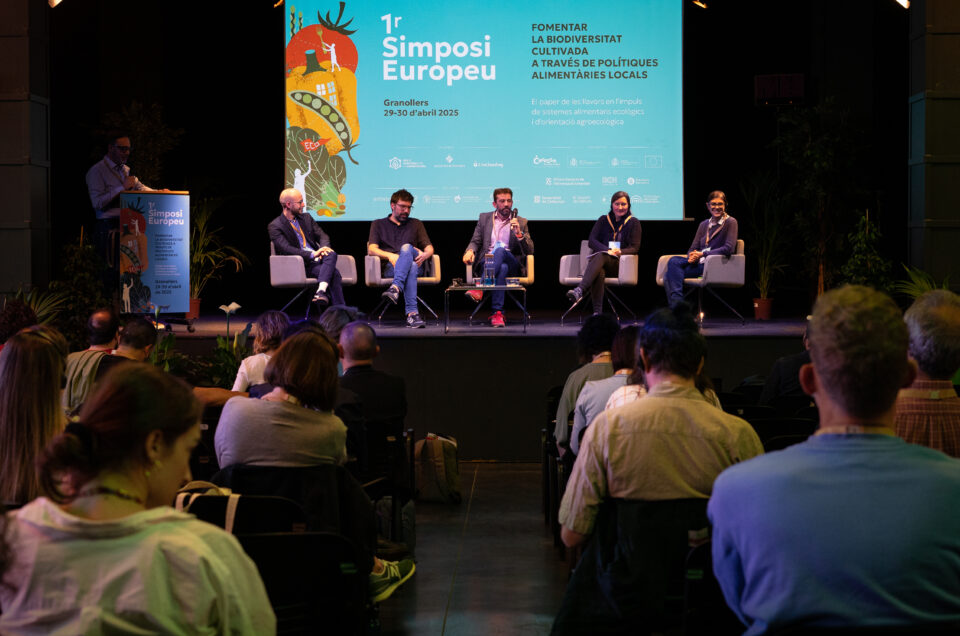
On 29 and 30 April 2025, the 1st European Symposium Fostering Cultivated Biodiversity through Local Food Policies was held in Granollers. The event brought together municipalities, public officials, experts and social actors to reflect on the central role of seeds in building organic and agroecology-oriented food systems that promote cultivated biodiversity in Europe.
Among many other related issues, the meeting addressed:
🌱 The importance of a diversified and resilient seed system as a foundation for sustainable food systems.
🏛️Multilevel legal, political and funding frameworks that ensure the promotion of cultivated biodiversity.
🤝Local experiences that promote organic seed systems and cultivated biodiversity.
🌍 The fundamental role of cultivated biodiversity in generating healthy food.
In the following Symposium summary video, you can hear some of the voices, debates, and initiatives presented during the event, which showed how local food policies can be a key tool for strengthening cultivated biodiversity and the agroecological transition in Europe.
The 1st European Symposium on Cultivated Biodiversity and Local Food Policies was the first global forum to put focus on the municipal action needed for integrating cultivated biodiversity in local food systems.
Initiatives from European cities were shared, such as Scandicci (Italy), Cork (Ireland) or Lyon (France), and Spanish ones like Aínsa and Orduña, which promote local seed systems through municipal actions.
Moreover, the host municipality, Granollers, presented its path highlighting projects such as:
📚Educational and awareness-raising programmes.
🌱Support to the Vallès Oriental Seed Bank, that recovers and promotes the use of landraces.
🥗 Promotion of local, biodiverse and organic products in school canteens and local markets.
🏞️Protection and enhancement of peri-urban agricultural land with the creation of the “Productes del Palou” brand.
The following video shows how local governments, through their closeness to citizens, can become engines of change toward more biodiverse, sustainable and resilient food systems.
On the other hand, Enrique Pueyo, Mayor of Aínsa-Sobrarbe and President of the Spanish Network of Municipalities for Agroecology, shared his vision about the challenges and opportunities of integrating cultivated biodiversity in local food policies.
In the interview, Pueyo stressed the importance of exchanging experiences among European municipalities to face shared challenges in related to local food and seed systems. He also emphasized the need to strengthen the resilience of local seed systems, pointing out that the current use of just a few varieties—for example, only eight types of apples dominate the global market— represents a weakness; versus the strength that a diet based on cultivated biodiversity brings.
Enrique Pueyo emphasized that local food policies are a key tool to recover diversity, strengthen food sovereignty and respond to the major social and environmental challenges of our time.
In the interview conducted during the 1st European Symposium on Cultivated Biodiversity and Local Food Policies, María Carrascosa (responsible for cultivated biodiversity at the Network of Municipalities for Agroecology) highlights the relevance of the event as an innovative space for dialogue between municipal responsibles and civil society.
Her contributions underline that:
🌱Municipalities are fundamental actors to transform the food system.
🥗Local food policy can integrate an agroecological transition approach and promote more biodiverse diets, bringing colour to fields and plates.
🤝Organized civil society can collaborate with municipalities to promote policies that enhance cultivated biodiversity and sustainability.
From her perspective, the Symposium served to reinforce the idea that local policies are key for developing resilient local food systems and enabling the agroecological transition.
Mariano Iossa, Coordinator of the LiveSeeding project, underlined the crucial role of the European Union in supporting cultivated biodiversity.
In his intervention he pointed out that:
The EU has a key role not only at the legislative level, but also in the distribution of funds and development of policies that directly affect farmers, plant breeders and local communities.
🌱To achieve a true transformation of food systems and guarantee resilience and sovereignty, the EU must direct its resources and policies toward cultivated biodiversity.
🤝Local communities, municipalities, seed banks, plant breeders, and producers are already doing fundamental work across Europe to promote this biodiversity.
In the view of Iossa, the EU has the opportunity—and the responsibility—to support with policies and funding what is already being built at the local level.
During the Symposium, Mariateresa Lazzaro, scientific coordinator of the LiveSeeding project and researcher at FiBL-Switzerland, laid out the importance of having biodiverse and resilient seed systems to ensure the sustainability and resilience.
In the interview she emphasizes that:
🌱A resilient and secure food system depends directly on a seed system based on cultivated biodiversity.
🌳It is necessary to integrate agroforestry, intercropping and the use of locally adapted seeds into sustainable production models.
🌍To face climate change, having seeds with high adaptive capacity, able to respond to increasingly variable and extreme conditions, is essential.
In her view, cultivated biodiversity is not just a matter of conservation, but a practical tool to build sustainable food systems ready for future challenges.
Michela Tudini, expert in Farmers’ Rights at the FAO, explains how the FAO’s International Treaty on Plant Genetic Resources for Food and Agriculture can contribute to the development of sustainable seed systems in Europe.
Her contributions highlight that:
📜The Treaty is legally binding and each country is responsible for implementing the necessary actions in terms of seeds and agrobiodiversity.
👩🏽🌾Articles 5 and 6 establish obligations regarding the sustainable use and conservation of plant genetic resources for food and agriculture.
📑Article 9 recognizes a fundamental right: the right of farmers to produce, sell and exchange their seeds.
⚖️The main challenge is to continue guaranteeing the conservation and free exchange of biodiverse seeds in the face of restrictive regulatory frameworks.
Tudini stresses that protecting the rights of farmers and the sustainable use of cultivated biodiversity are essential pillars to build fairer, more sustainable and resilient food systems.
Ernest Tasias presented the experience of Les Refardes, a Catalan cooperative dedicated to organic seeds production of landraces and open pollinated varieties.
In the interview he explains that:
🌱Les Refardes groups together 24 producer farms, and coordinates the seed production, cleaning and marketing.
🥕 Its main objective is to normalize the use of landraces and open pollinated varieties and organic seeds seeds in Catalan agriculture.
🏛️ To strengthen the sector, it is crucial that public administrations support local organic seed producers, guaranteeing a favourable supporting framework.
As a capstone to the two days of the Symposium, Ernest, together with María Riera, partner at Les Refardes, guided participants on a visit to the Mas Roig farm.
Ernest’s testimony shows how cooperative organisation can drive cultivated biodiversity, and how institutional support is decisive to scale up such initiatives.
Finally, Xènia Torras presented the work of the Catalan Seed Network (Xarxa Catalana de Graners), created in 2003 that today brings together 14 community seed banks of landraces in Catalonia.
In the interview she explains that:
🌱The network works on recovering traditional seeds together with associated knowledge: how are they grown, conserved and used.
📚In addition to describing and assessing these varieties, its mission is to disseminate them and return them to the fields, both of professional and hobby farmers.
💪They seek to empower society through cultivated biodiversity, indispensable for the sustainability of local food systems.
Their experience reflects how community seed bank networks are essential to recover agricultural heritage and ensure a more diverse and resilient food future.